Fashion ecommerce has a return problem. Not a small one.
Across the industry, apparel return rates hover between 30% and 40% for online purchases, compared to roughly 9% in physical retail, according to the National Retail Federation. The core reason shoppers send items back is almost always the same: the item didn't look the way they expected. Wrong fit, unexpected color, fabric that reads differently on a model than it does on their body.
This gap between expectation and reality costs fashion brands not just in reverse logistics, but in customer trust. A shopper who returns twice is already looking at your competitors.
Why Shoppers Return Fashion Purchases Online
Return behavior in fashion ecommerce is driven by a predictable set of frustrations:
Fit uncertainty. Sizing is inconsistent across brands, and even within a single brand across product lines.
Inaccurate color representation. Product photography varies by lighting, monitor calibration, and editing choices.
Fabric and texture uncertainty. Shoppers cannot feel the material. What reads as "structured" in a description may arrive feeling stiff or flimsy.
No context for how the item looks on their body. Generic flat lays or model shots give minimal information to a shopper who is 5'4" and petite, or 6'1" with a broad frame.
According to Shopify research, 64% of online shoppers say they've returned a fashion item specifically because it didn't fit the way they expected. That number has remained stubbornly high despite improvements in product descriptions and size guides.
The problem is structural. Static product images, however well-produced, cannot replicate the experience of trying something on.
How AI Virtual Try-On Addresses the Root Cause
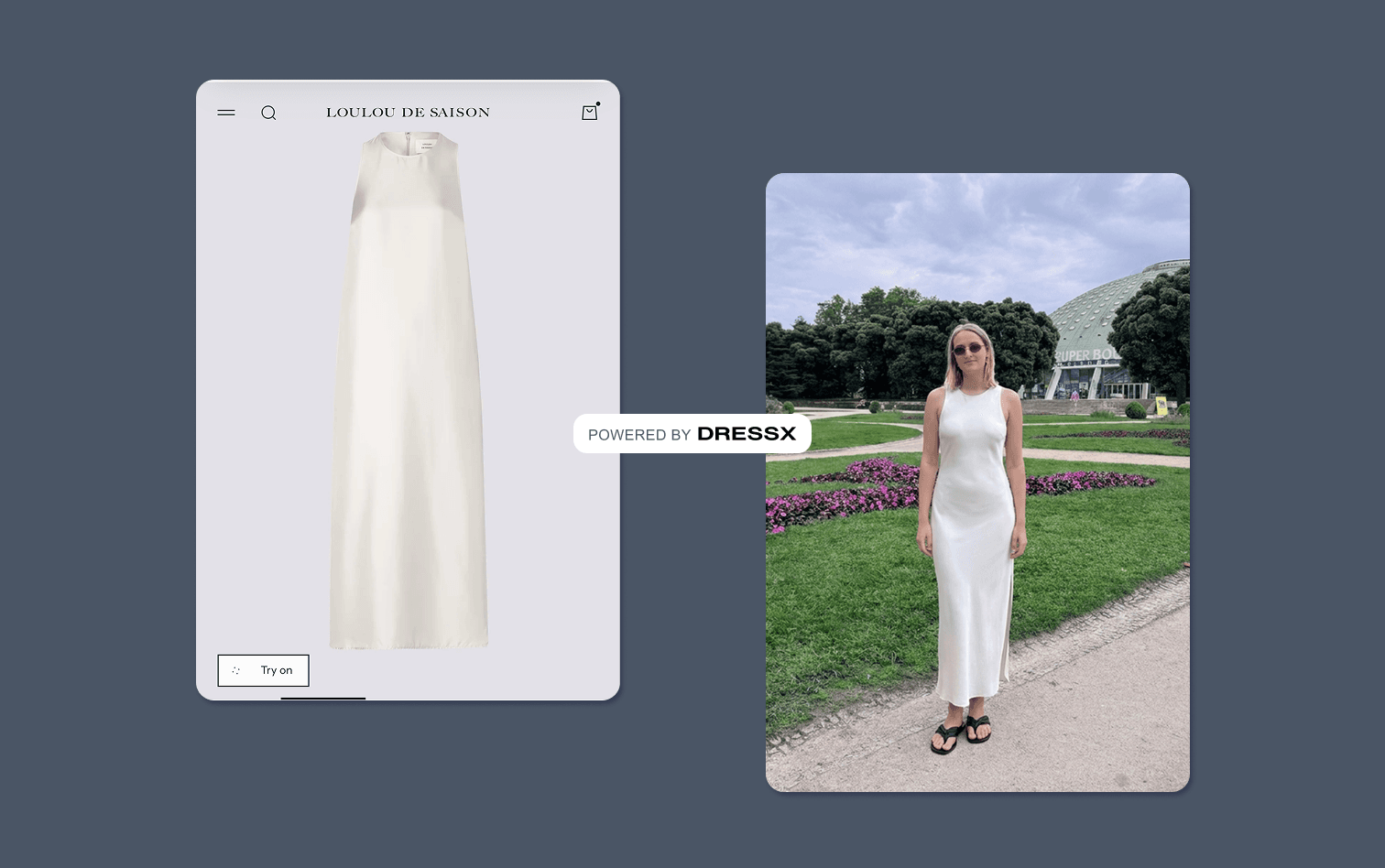
AI virtual try-on technology lets shoppers visualize how a garment looks on a body representative of their own, before purchasing. It doesn't just add a visual layer to the product page. It changes the nature of the buying decision.
What does AI virtual try-on actually do?
It uses AI to place a garment realistically onto a person's image, preserving fabric texture, drape, fit, and proportions. The result is a product visualization that reflects how the item would actually look when worn, rather than how it looks on a hanger or on a single standard model.
For fashion brands, this addresses the core driver of returns directly. Shoppers who can see themselves in a garment make better-informed decisions. They are less likely to order speculatively and more likely to keep what they buy.
What DRESSX Virtual Try-On Offers Fashion Brands
DRESSX Virtual Try-On was built specifically for fashion and luxury ecommerce. It integrates into existing product pages and digital infrastructure without requiring a platform rebuild.
Key capabilities
Photorealistic rendering. The technology handles complex fabrics accurately, including denim, knitwear, and layered looks.
Scalability across catalog. It works across large product catalogs, not just hero items or seasonal campaigns.
Seamless integration. DRESSX Virtual Try-On connects with existing ecommerce infrastructure, including Shopify stores.
Enterprise-grade reliability. Built for the demands of high-traffic fashion and luxury brands.
The results brands report are consistent: higher conversion rates, lower return rates, and stronger shopper confidence at the moment of purchase.
👇🏻 If you want to understand how virtual try-on fits within a broader AI strategy for fashion retail, this article on the DRESSX AI Suite is worth reading first.
The Business Case: Returns Are a Profitability Problem
Fashion brands often treat returns as a logistics issue. The better frame is a profitability issue.
The cost of processing a single apparel return, including reverse shipping, inspection, restocking, and potential markdowns, ranges from $10 to $30 per item, according to Optoro's retail returns research. At scale, this adds up fast. For a brand processing 50,000 returns per year at an average $20 cost per return, that's $1 million in return processing costs alone, before accounting for lost margin on marked-down inventory.
There's also a customer lifetime value dimension. Shoppers with frequent negative return experiences don't become loyal customers. They simply stop buying. According to McKinsey's State of Fashion report, customer acquisition in fashion ecommerce costs 5x more than retention. Every return that ends in churn is a compounded loss.
Reducing return rates by even 10 to 15 percentage points meaningfully changes a brand's unit economics.
Virtual Try-On as a Conversion Tool, Not Just a Return Reducer
The commercial impact of AI virtual try-on extends beyond returns.
Shoppers who interact with a virtual try-on experience spend more time on the product page and convert at higher rates. Confidence at the moment of decision translates directly to purchase. Brands using virtual try-on report conversion rate improvements ranging from 20% to over 40%, depending on category and implementation.
There is also a differentiation argument. As virtual try-on adoption grows across the industry, the question is shifting from "should we invest in this?" to "how do we do it better than our competitors?" Zara's move into AI try-on signals where the category is heading. DRESSX's analysis of that shift is worth reading if you're mapping the competitive landscape.
💡 Pro tip:
Virtual try-on performs best when it's integrated into the primary product page, not hidden behind an extra click or a separate feature tab. Placement at the point of decision is what drives the conversion impact.
Which Fashion Brands Benefit Most from Virtual Try-On?
AI virtual try-on delivers the highest ROI for brands where:
Return rates are already high. If your apparel returns exceed 25%, the economics of reducing them are compelling.
Your catalog includes fit-sensitive categories. Denim, tailoring, knitwear, and formalwear are all high-return categories where try-on addresses a genuine purchase barrier. Denim in particular is one of the hardest categories to sell online accurately, and this article explains exactly why.
You sell to a diverse customer base. Generic model shots are least useful for shoppers who don't see themselves represented. Try-on technology closes that gap.
You operate across channels. Try-on capability strengthens omnichannel consistency by giving online shoppers a comparable level of assurance to in-store.
Frequently Asked Questions
What is AI virtual try-on for fashion? AI virtual try-on is technology that places garments onto a shopper's photo or a representative model image using AI, showing how a specific item would look when worn. It allows shoppers to evaluate fit, proportions, and styling before purchasing.
Does AI virtual try-on actually reduce returns? Yes. Return rates in fashion ecommerce are primarily driven by fit and expectation mismatches. Virtual try-on addresses both by giving shoppers a more accurate visualization of how a garment will look on their body before they commit to a purchase.
How does DRESSX Virtual Try-On integrate with existing ecommerce platforms? DRESSX Virtual Try-On integrates with existing digital infrastructure including Shopify stores and enterprise ecommerce platforms. It is designed for seamless implementation without requiring platform rebuilds.
Which garment categories benefit most from virtual try-on? Fit-sensitive categories see the strongest impact: denim, tailoring, knitwear, formalwear, and outerwear. These are the categories with the highest return rates and the most purchase hesitation.
Is virtual try-on only for large fashion brands? No. DRESSX offers virtual try-on solutions for both enterprise fashion brands and Shopify stores, making the technology accessible across different scales of operation.
Returns Are a Solvable Problem
Fashion ecommerce returns are not inevitable. They are largely a symptom of insufficient purchase confidence, and purchase confidence is solvable with the right technology.
The brands that address this now are building an advantage that compounds. Lower return rates improve margin. Higher conversion rates improve revenue. Better shopper experiences improve retention. These effects reinforce each other.
AI virtual try-on is the most direct lever available to fashion brands today for addressing all three.
If you're evaluating how to reduce returns and improve conversion in your ecommerce operation, DRESSX Virtual Try-On is worth a closer look.